
Freeport Previous Residents Source Years
Previous residents research in Freeport moves across several eras. Current Nassau parcel data provides the starting SBL and recorded owner. County Clerk records trace legal transfers. Maps test whether the old parcel and street line are comparable. Directories, yearbooks, newspapers, and census schedules can add a dated household clue. Each source is limited, so a strong conclusion needs a map or parcel identity, a deed or legal transfer, and a dated directory, census, school, or newspaper clue that fits the same place.
| Source | Years It Covers | Where Held | What It Shows |
|---|---|---|---|
| J.H. Hunt directory Freeport section | 1894 | NY Heritage; original at Freeport Historical Society and Museum | Printed inhabitants and business listings, image-only |
| Nassau County Clerk registry and deeds | 1899 onward; older index books available | Current portal, historic repository, public terminals, County Clerk | Grantors, grantees, dates, legal descriptions, and recorded instruments |
| Sanborn fire-insurance map | 1910 | Library of Congress | Thirty sheets showing buildings and uses, not occupants |
| Freeport tax maps | 1915, 1925, 1930, 1935 | Library guide and Historical Society | Street and lot geometry, with map-label clues where shown |
| Yearbooks and address transcriptions | 1927-2005; transcription years 1934-35 | NY Heritage and Freeport Memorial Library | Dated school and address clues, not every household |
| Federal census | Through 1950 | National Archives | Enumerated household and enumeration-district clues |
| Current final roll and LRV | 2025-26 roll/LRV context | Village and Nassau systems | Current parcel, owner, mailing distinction, and map reference |
Freeport As It Was, published in 1976, names a 1923-24 directory as a source lead. Use it to plan a repository request, but do not describe it as a fully inspected online directory. The same rule applies to a newspaper catalog entry: it identifies a possible run, not a proved household event.
Freeport Previous Residents Start With Parcels
Start an address history with the Nassau Land Records Viewer or the Village final assessment roll. Save the current street form, SBL, property location, owner name, owner mailing address, roll year, and any deed book and page. The LRV address search uses house number, street name, town, and ZIP; its SBL search uses Section, Block, and Lot. County Clerk and assessment systems can format an SBL differently, so preserve both the displayed parcel key and the original address before changing systems.
The 81 Lillian Avenue roll example shows why roles matter. It lists a Freeport situs but sends the tax notice to an owner mailing address in Merrick. That relationship can lead to a recorded deed, but it does not establish who lived at the property. A parcel may also contain a lot group, a split, a merger, or a legal description that no longer looks like the modern street address.
- Situs address
- The location assigned to the parcel for mapping and assessment, which is different from a tax-notice mailing address.
- SBL
- Section, Block, Lot, the local parcel identifier used in rolls and land-record research.
- Legal description
- The land description in an instrument, often the most durable way to match an older transfer to a parcel.
Freeport Previous Residents Deed Index
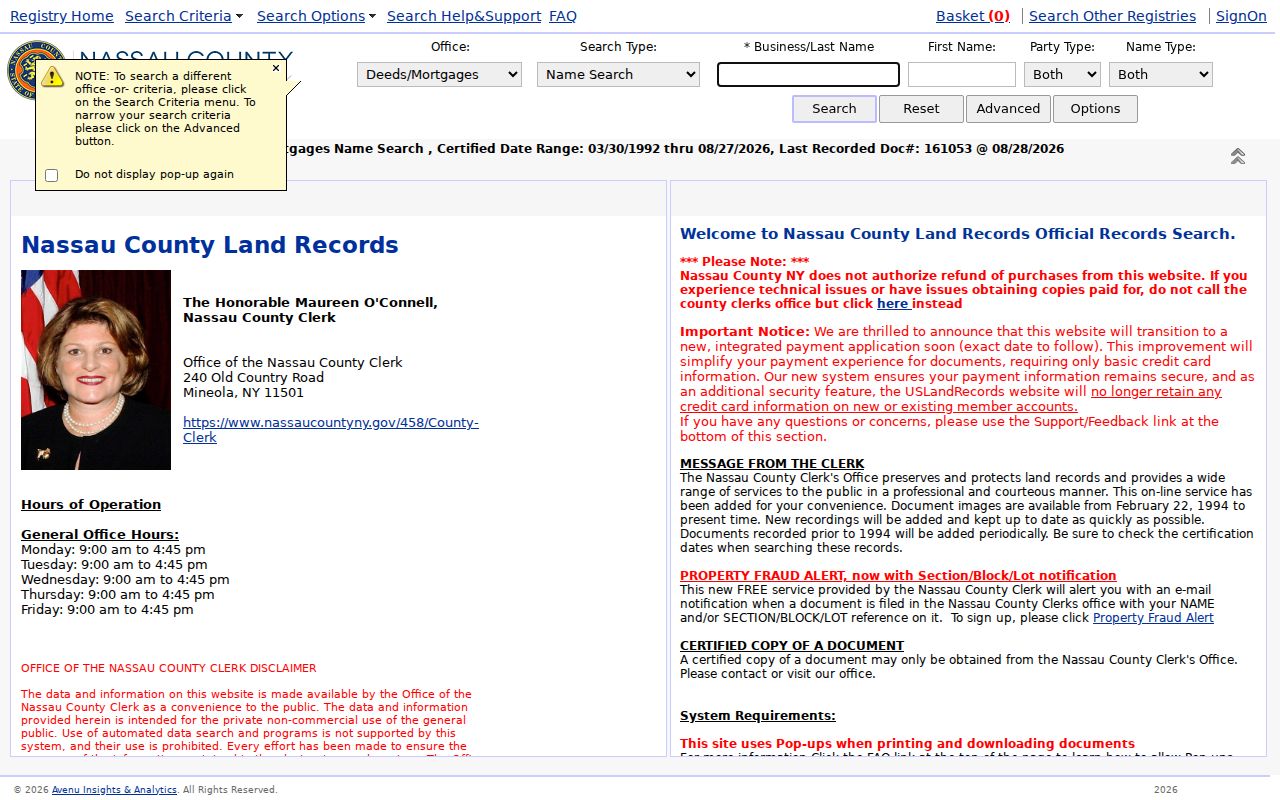
Use the Nassau County Clerk's current Land Records II portal first for a current recorded-document search by SBL or party. Its live field labels, image rules, and coverage details were not fully rendered in the research, so verify the portal's present controls at the time of a search. If a web result is incomplete, the County Clerk offers public terminal, in-person, mail, delivery, and drop-box channels for documents. Mail requests should include the document or book-page detail, payment or prepaid account, and a self-addressed stamped envelope.
The source image below is from the current County Clerk deed portal.
The County Clerk's historic repository is the backward route. It exposes Document Name or Book Number, Record Type, document-text search, a year range, and browse links for Index Books 1840-1934, Direct Index Books, Reverse Index Books, and historic plat books. The repository says it has no documents after 1982. That does not mean all later deeds are missing, only that later work belongs in the current portal or at the Clerk.
The source image below is from the historic County Clerk index search.
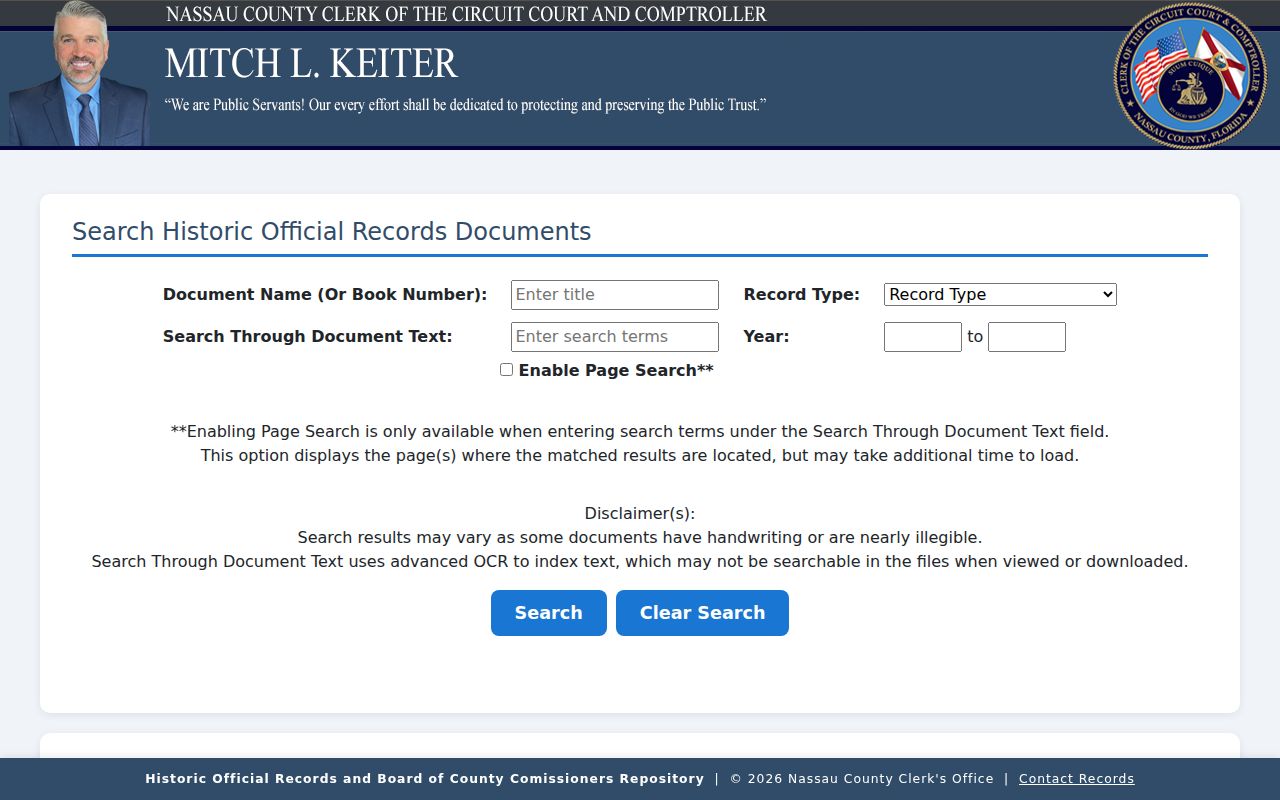
Search document text carefully. OCR can miss handwriting and weak images, and the record type options were not fully captured in the official source review. A reported registry history back to 1899 for deeds, mortgages, and maps is not a promise that every instrument has a uniform online image.
Tracing Freeport Previous Residents Through Deeds
The deed chain follows the parcel, not merely a surname. Find the newest purchase deed for the current owner. Its grantor is the seller, while its grantee is the buyer. Then search the seller as grantee to find that person's earlier purchase. At each step compare SBL, lot or map reference, legal description, recording date, book and page or document number, and any parcel split or combination. A deed party might be an estate representative, trustee, lender, or corporation, so it is evidence of a transfer role rather than a household list.
- Use LRV or the roll to capture the current SBL, situs, owner, and any displayed deed book and page.
- Search the current portal by SBL or party, and save the latest instrument's grantor, grantee, date, identifier, and legal description.
- Search that grantor as a prior grantee, checking the same legal parcel before adding it to the chain.
- Move into historic Direct and Reverse Index Books when the period fits, then use a public terminal or County Clerk request for missing images.
- Place each transfer beside maps and dated household clues rather than assuming the legal owner was a resident.
- Grantor
- The party conveying an interest in the recorded instrument, often the seller in a deed.
- Grantee
- The party receiving that interest, often the buyer in a deed.
- Chain of title
- The linked sequence of recorded transfers for the same legal parcel.
Freeport Previous Residents Map Series
Maps supply the first of the three independent tracks. The 1910 Library of Congress Sanborn map has 30 Freeport sheets and can show a building footprint, block form, and use at that time. It cannot name the people in a building. The 1915, 1925, 1930, and 1935 tax maps add a local time series for street and parcel comparison. Nassau LRV also provides 1926 and 1950 historic layers, which can help test whether a street alignment or lot grouping changed.
The source image below comes from the Freeport Memorial Library house-history guide.
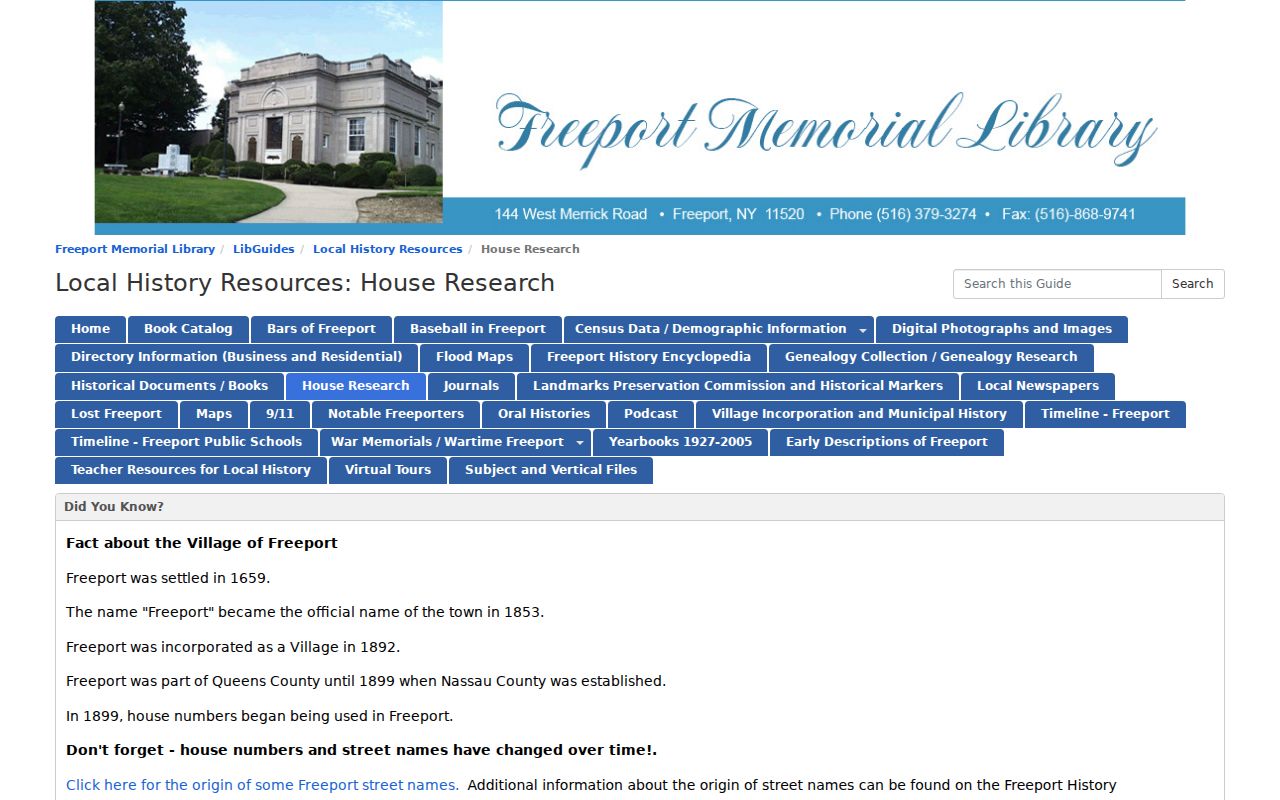
Use the same street, lot, and block references across each map. When an address does not appear, test the historical place names Raynortown, Raynor South, and South Hempstead and compare the parcel shape. No official Freeport street-renumbering schedule was found, so a mismatch should be treated as a research problem to resolve, not evidence of an invented renumbering event.
Freeport Previous Residents Reverse Index
Historic Direct and Reverse Index Books are a distinct Nassau research advantage. The historic repository exposes index books from 1840 through 1934, alongside direct and reverse browsing. That earlier browseable series is different from the County Clerk's reported 1899 registry history for deeds, mortgages, and maps. Treat the two dates as descriptions of different series, not as a guarantee that every old book has a digitized image or complete search entry.
For the household layer, Freeport's 1934/35 yearbook transcriptions can be searched by surname or address. The local historical collections, including the 1894 scan, yearbooks, and the 1923-24 lead, are described in more detail in the Freeport city directory. Bring the parcel's dated map and deed clues to that search so a similar surname does not pull the trail onto another street.
The digitized 1894 Freeport directory is a 13-page, image-based compound item.
Use its printed name, address, and business clues as a dated household lead, then compare the scan with the parcel and map evidence.
Freeport Previous Residents Census Pairing
The household side of an address history needs a dated personal clue. Pair a directory, school record, newspaper notice, or address transcription with the census schedule available for that period. The National Archives releases individual federal census schedules after 72 years, making 1950 the current public endpoint. The 1960 and later individual schedules are not public ordinary online records. An enumeration record can describe a household in a historical setting, but it must still be reconciled with the street form and map.
- Choose a directory, yearbook, or newspaper item whose date fits the deed interval.
- Compare its address with the tax map, Sanborn sheet, or historic LRV layer for the same period.
- Locate the fitting census schedule and enumeration-district context, then record the census year and source.
- Keep owner, occupant clue, and map evidence in separate columns until all three converge.
Freeport Memorial Library and the Freeport Historical Society provide the local fallback for books, maps, newspapers, manuscripts, and photographs. The Historical Society works by appointment at 350 South Main Street and can be reached at 516-623-9632. Its record holdings support historical research, but an archive item can still have access or redaction limits.
Freeport Previous Residents Legal Limits
Past-resident work is for house history, family history, estate questions, and careful local research. It should stop at a privacy boundary. A current owner, historic directory line, or census entry does not authorize disclosure of contact details or an attempt to locate a living person. Use a finding only for the limited record question that it answers, and check the underlying custodian when an image, certified copy, or a protected record is involved.
The source image below comes from the Freeport Historical Society and Museum holdings description.
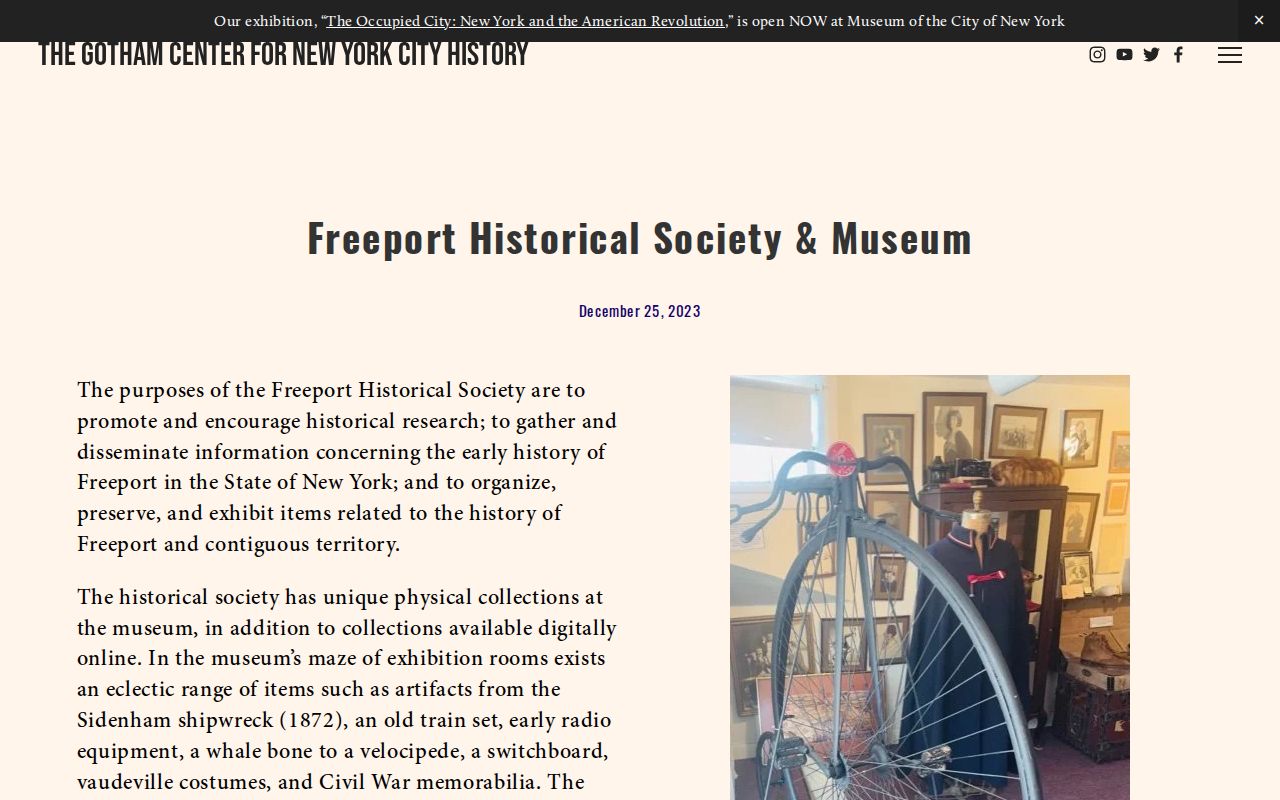
The Society is described as a state-approved alternative repository for nonconfidential local-government records. Ask for a specific collection, period, street, or map rather than a broad personal file. Note: Careful house-history research preserves source dates and uses, while keeping living people and protected addresses out of the historical trail.